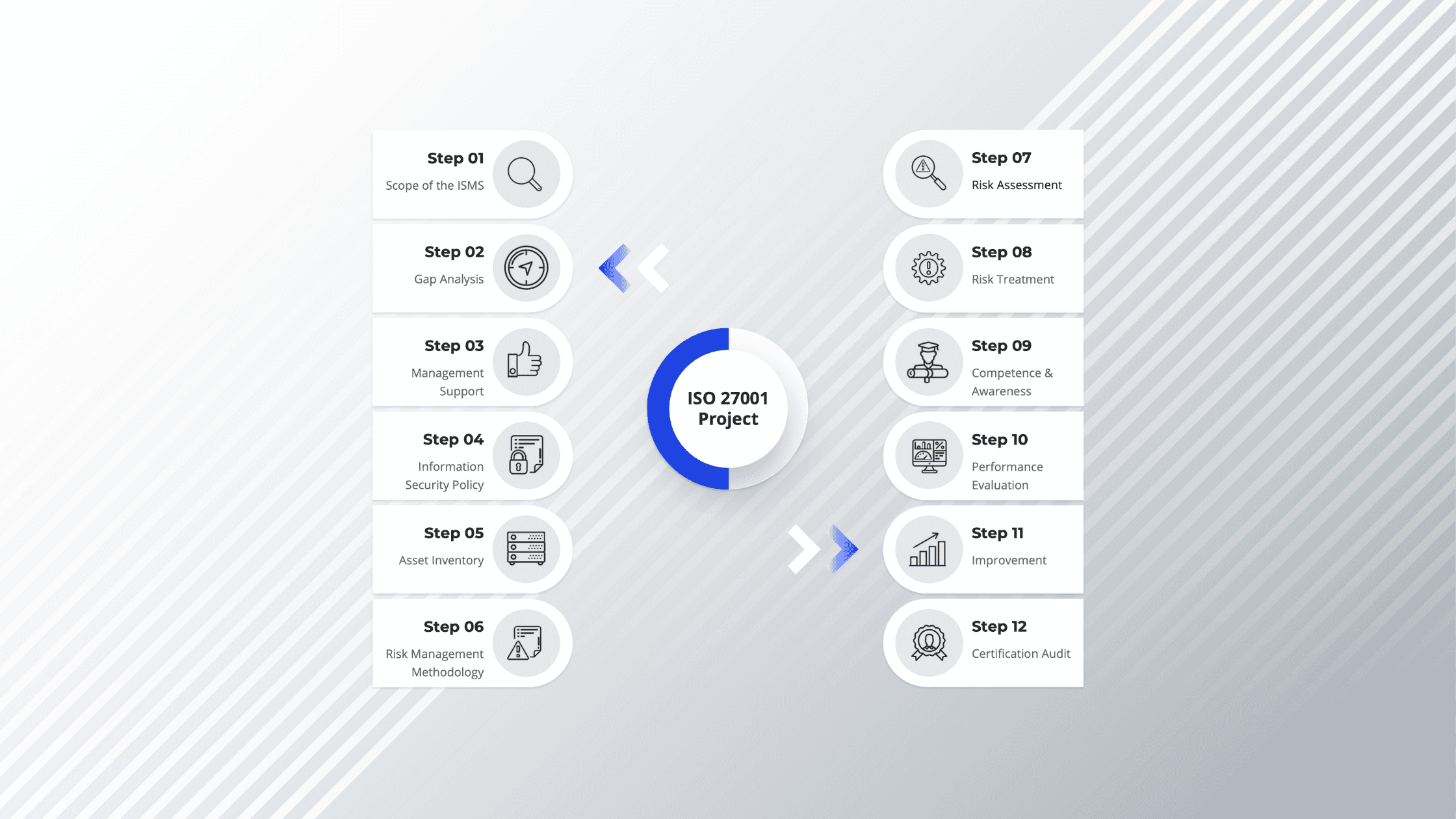

Achieving ISO/IEC 27001 certification is one of the clearest ways to prove your organization takes information security seriously. But getting there is hard: the standard tells you what is required, not how to do it, and the work spans the whole organization — from leadership to IT to HR. Poor planning is the single biggest reason implementation projects stall, run over budget, or quietly fall apart.
The antidote is a clear sequence. This article lays out a proven 12-step roadmap that works for any organization, regardless of size, type, or industry. Each step builds on the one before it, so the project moves forward in a logical order rather than in scattered, overlapping efforts. Think of it as the flight plan for the entire implementation.
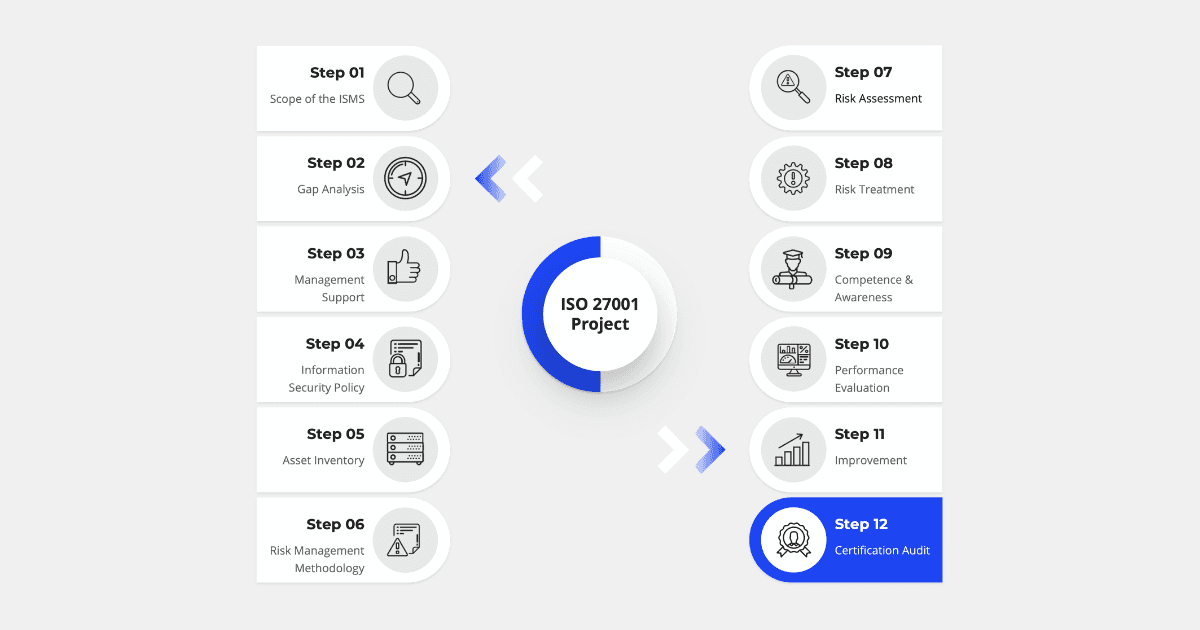
Why the order matters
The 12 steps are not arbitrary. Each one produces something the next step needs. Scope defines the boundaries the gap analysis measures against. The gap analysis produces the evidence that wins management support. Management support authorizes the policy and resources. And so on, all the way to the certification audit. Following the sequence is what keeps you from doing work twice — or discovering a missing foundation halfway through.
Step 1: Scope of the ISMS
Define what the Information Security Management System (ISMS) covers — which parts of the organization, which processes, assets, and locations are in and out. A clear scope aligns the ISMS with business objectives and sets a realistic boundary for everything that follows. The boundaries you set here are exactly what the gap analysis in Step 2 will assess.
Step 2: Gap Analysis
Measure your current security practices against the standard's requirements, within the scope you just defined. The gap analysis shows where you already comply and where you fall short — and, just as importantly, it produces the evidence base for the business case you will put to management in Step 3. This turns the request for commitment into an evidence-driven proposal rather than a generic appeal.
Step 3: Management Support
Secure genuine commitment from top management. Positioned deliberately after the gap analysis, this step lets you make an evidence-based case using concrete findings instead of vague warnings. Leadership commitment is what gives the project the budget, authority, and priority it needs — and it is mandated by the standard, not optional. The business case secured here feeds directly into the project charter and the information security policy that follow.
Step 4: Information Security Policy
Develop the Information Security Policy together with your security objectives. Issued by top management, this policy is a formal statement of intent: it sets the tone, aligns the ISMS with business goals, and mandates participation across every level of the organization. It becomes the reference point for all the security activities that come after it.
Step 5: Asset Inventory
Identify and classify the information assets you need to protect — data, hardware, software, processes. You cannot assess risk to something you have not identified, so the inventory is the necessary input to the risk work ahead. Assigning owners and classifications here makes every later decision about protection clearer.
Step 6: Risk Management Methodology
Before assessing any risks, define how you will assess them. This step establishes a repeatable method: your risk criteria, how you will score likelihood and impact, and your risk acceptance thresholds. A consistent methodology is what makes your results defensible and comparable rather than ad hoc.
Step 7: Risk Assessment
Put the methodology to work. Identify, analyze, and evaluate the risks to your information assets, then prioritize them against your acceptance criteria. The result is a clear, documented picture of your organization's risk exposure — the foundation for deciding what to actually do about it in Step 8.
Step 8: Risk Treatment
Decide how to handle each significant risk — mitigate, avoid, share, or accept it — and select the controls to do so, drawing on Annex A's 93 controls or other frameworks. This step also produces the mandatory Statement of Applicability (SoA), which records which controls you have selected and why. This is often the most effort-intensive phase, as implementing controls can spawn several sub-projects.
Step 9: Competence & Awareness
Make sure people have the skills and awareness to play their part in the ISMS. Placed here on purpose — after risk treatment — so that training targets the actual risks and controls you have chosen, rather than generic security advice. Information security is a collective responsibility, and this step equips everyone from executives to frontline staff to uphold it.
Step 10: Performance Evaluation
Check whether the ISMS is actually working. Through monitoring, internal audits, and management review, you confirm the system is operating as intended and surface areas that need attention. This step validates the work done so far and prepares you for the certification audit.
Step 11: Improvement
Act on what the evaluation revealed. Address nonconformities, carry out corrective actions, and make improvements that keep the ISMS effective as risks and the business change. Continual improvement is a core principle of the standard — and the habit that keeps certification sustainable rather than a one-off scramble.
Step 12: Certification Audit
The final step. An accredited certification body validates your ISMS through a two-stage audit — a documentation review (Stage 1) followed by an assessment of how the system works in practice (Stage 2). Pass it, and you earn the ISO 27001 certificate: third-party proof of everything the previous eleven steps built.
From Roadmap to Execution
Knowing the 12 steps is the easy part. The hard part is execution: breaking each step into concrete tasks, producing the documents an auditor expects, and keeping the project moving without losing weeks to a blank page or a missed requirement. This is also where judgment matters most — AI can draft a policy in seconds, but it cannot scope your ISMS, defend your control selection to an auditor, or tell you whether its own output fits your organization. That applied understanding is what carries a project through.
Our ISO/IEC 27001 Lead Implementer Toolkit turns this roadmap into a working system: a customizable project plan with 400+ sequenced tasks and 7 milestones, more than 20 ISO-aligned policy and document templates, mind maps, and bonus control mappings. It is built for real implementations by a practising ISO 27001 Lead Auditor, so you start from a proven structure instead of a blank page. Pay once for lifetime access and updates — no subscription.
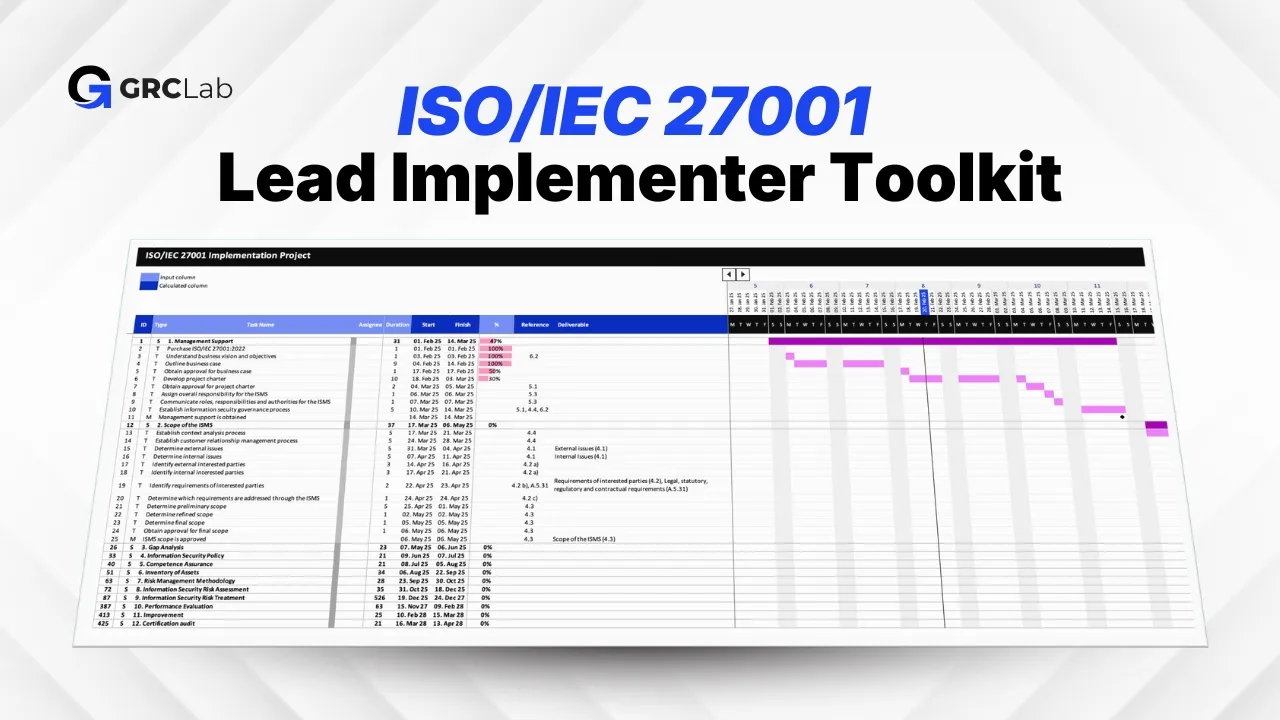
Ready to go deeper? Each of the 12 steps has its own detailed article in this guide, walking through the required activities, deliverables, and the relevant ISO 27001 clauses. Start with Step 1: Scope of the ISMS.