

ISO/IEC 27001 is built on a single, powerful idea: that security should be run as a system, not handled ad hoc. To understand the standard, you first need to understand what a management system is and why it works. This article breaks down three building blocks — management, systems, and management systems — and shows how they combine into an Information Security Management System (ISMS).
It is written for anyone new to ISO standards. The concepts are simple, but they explain why ISO 27001 is structured the way it is.
What is Management?
Management is the work of steering an organization toward its objectives — through planning, organizing, and leading. It keeps resources and effort pointed in the same direction. Its core components are:
Strategy: A plan for reaching long-term goals despite uncertainty, guiding what gets prioritized.
Coordination: Directing and adjusting operations so they run smoothly together.
Resource allocation: Assigning time, money, and people where they deliver the most value.
Objectives: The specific outcomes the organization is working toward, such as stronger security or greater customer trust.
Clear roles make this work. A RACI matrix (Responsible, Accountable, Consulted, Informed) is a simple way to remove ambiguity. In a security context, for example, a CEO is accountable for overall strategy, a CISO is responsible for security implementation, and a SOC analyst is consulted on incident response and informed of security events. Everyone knows their part.
What is a System?
A system is a set of interconnected parts working together toward a goal. In an organization, a system arranges resources, activities, and processes to produce consistent results. Its defining traits are:
Interconnected elements: People, technology, and processes that interact to produce an outcome.
A defined purpose: The system exists to achieve something specific.
A structured flow: Inputs are transformed through activities into outputs.
A customer complaint process is a simple example: a complaint comes in (input), defined steps investigate it (activities), and a resolution comes out (output). In ISO 27001, processes like access control and backup work the same way — taking inputs and reliably producing a secure result.
What is a Management System?
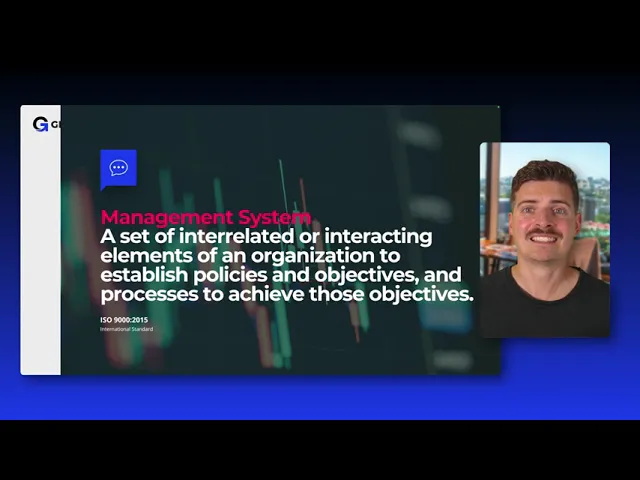
A management system combines management principles with systematic structure to achieve a specific objective — quality, safety, or information security. It provides a repeatable framework for planning, running, and improving operations, so results do not depend on any one person remembering to do the right thing. Its key elements are:
Structure: How the organization is arranged — departments, reporting lines, authority.
Policies: Formal guidance from leadership that shapes decisions and behavior.
Roles and responsibilities: Clear ownership of tasks and accountability, often mapped with a RACI matrix.
Objectives: Defined goals, broken into activities, resources, owners, timelines, and ways to measure success.
Culture: The shared values and behaviors that determine whether the system is actually followed.
Processes: The activities that turn inputs into reliable outputs.
ISO publishes management system standards across many disciplines, which all share this same structure:
ISO 9001: Quality management, for consistent products and services.
ISO 45001: Occupational health and safety, for worker well-being.
ISO 14001: Environmental management, for sustainable practice.
ISO/IEC 27001: Information security management, for protecting the confidentiality, integrity, and availability of information.
Because they share a common structure, an organization already certified to one ISO management system standard will recognize much of the next. This shared backbone is called the Harmonized Structure, and it is what lets ISO 27001 integrate cleanly with standards a business may already run.
Why a System Beats Ad Hoc Security
This is the heart of why ISO 27001 exists. Plenty of organizations "do security" — a firewall here, a policy there, a tool someone championed. The problem is that ad hoc security is invisible and unrepeatable: no one can prove it works, and it falls apart when a key person leaves.
A management system makes security governed, measurable, and improvable. It is also what an auditor assesses — not whether you own good tools, but whether you run a system that reliably produces secure outcomes and can demonstrate it. That distinction is the difference between looking secure and being able to prove it.
Where to Go Next
You now understand the framework behind the standard: security run as a structured, repeatable management system. The next step is to see how ISO/IEC 27001 puts this into practice — its purpose, its structure, and the PDCA cycle that drives continuous improvement. Continue with Understanding ISO 27001: A Beginner's Guide.